Plain: a free Markdown reader and editor, because $15 was too expensive
7 Sep 2026 ↗
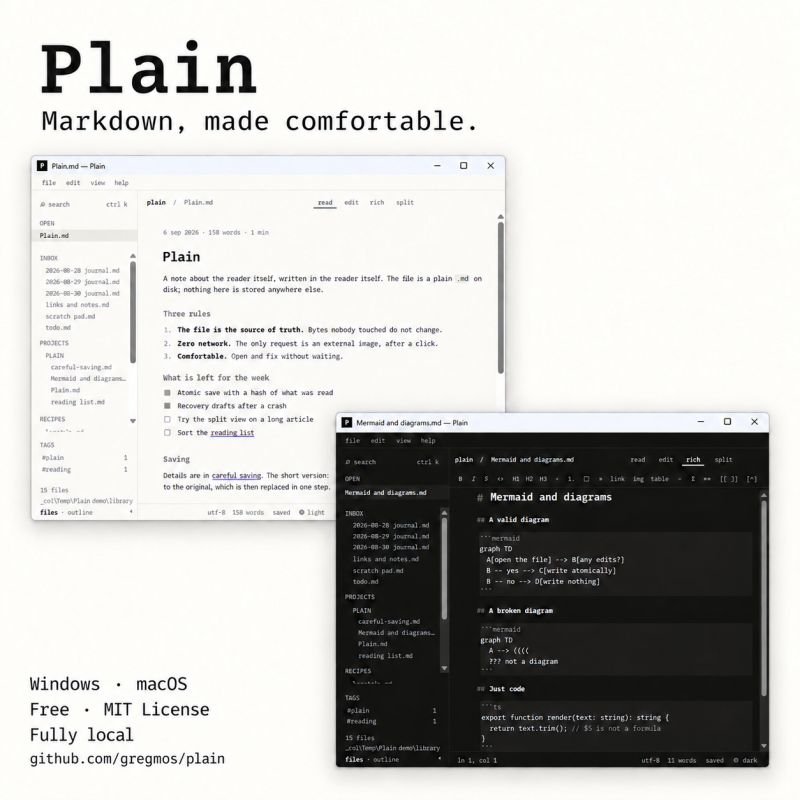
I have a $200 Claude subscription. Obviously, a $15 .md reading/editing app was too expensive to buy. Almost everything I get out of LLMs these days is markdown, and I wanted a comfortable way to read and edit it. I could have bought Typora. Instead, I built Plain, a free, open-source Markdown reader and editor for Windows and macOS. Inside: three views of the same file (reading, syntax-highlighted source, rich editing with the syntax hidden) plus a Word-style toolbar and split view; tables, checklists, footnotes, callouts, KaTeX, Mermaid, pasted images; any folder as a library with file tree, quick open, full-text search, tags and backlinks; careful saving — untouched bytes stay untouched, atomic saves, crash-recovery drafts, 30-day version history; fully local, no server, no account, no database. MIT-licensed, installers on GitHub.
Legal engineer: a salesman, a builder, or both?
3 Sep 2026 ↗
I see a lot of Harvey Legal Engineer Certificates in my feed, so I looked into the program. For Harvey, a legal engineer has practiced law, knows LLM basics, thinks in workflows, explains things in plain terms and sees the pain points of a legal department: a connector between the solution and the customer. In-house job posts shift the focus to knowing the tools on the market and matching tool to process. Neither asks a legal engineer to build, although the word "engineer" is right there in the title. My take: a legal engineer is basically a product manager for legal work. Hypotheses, MVPs, breaking and rebuilding, data, workflow and UX design. Building is not a prerequisite, it is just the fastest way to test a hypothesis in 2 days instead of a month. Salesman or builder? Both are tools. The job is to find the right problem and prove you fixed it.
PII Shield now runs as a CLI
17 Jun 2026 ↗
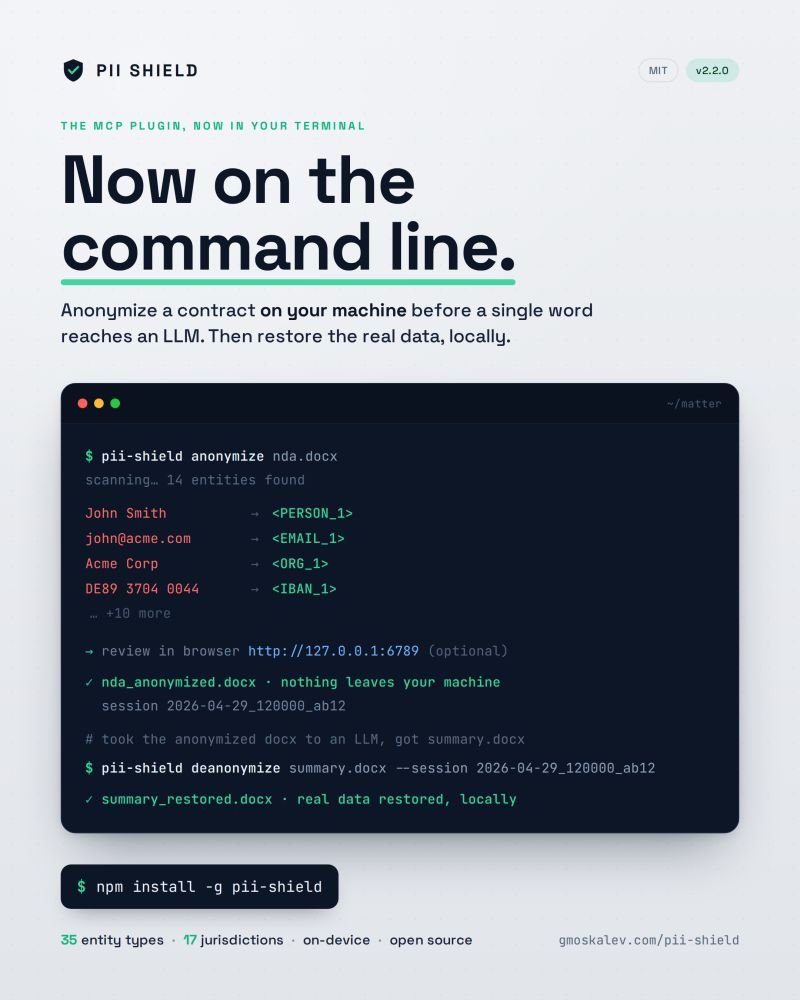
Anonymize any document locally before it reaches an LLM, then restore the real data on your machine. 35 entity types across 17 jurisdictions, on-device, open source. Build it into your workflow. Open a PR or an issue, and tell me what it misses. npm install -g pii-shield
Shared matter context: the next battleground in legal tech?
12 Jun 2026 ↗
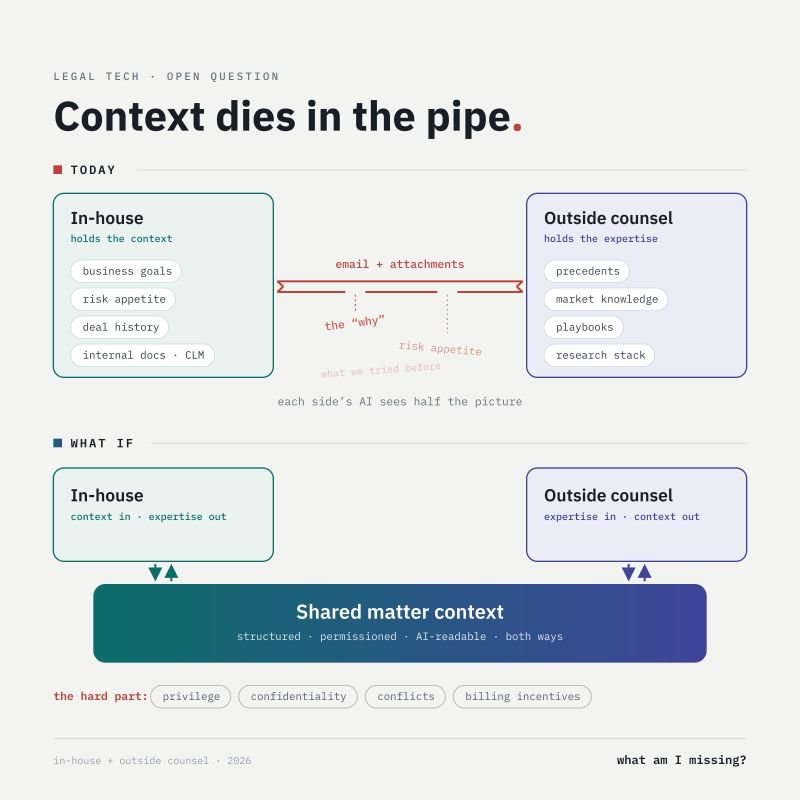
Most legal AI tools are built for one of two situations: a lawyer working alone, or a team inside one company. But a big chunk of legal work happens between two organizations, in-house and outside counsel, and that work still runs on email and attachments. In-house knows why the question came up and how much risk the business can live with. The firm knows how the market usually handles it. So each side's AI only sees its own half of the picture. Harvey and Legora are moving in this direction, but privilege, confidentiality, conflicts and hourly billing look much harder to solve than the tech itself. Will shared matter context become the next battleground, or does the trust problem kill the idea?
Mourning the junior lawyer misses the actual problem
9 Jun 2026 ↗
Part of my feed is mourning the junior lawyer, killed off by AI: no entry-level work, no way to learn, no path to senior. Firms have always trained juniors the way guilds trained apprentices: watch a senior, copy them, pick it up over years. AI now does much of that entry-level work, but the work was never the point. It was how juniors absorbed judgment and a feel for how the firm thinks. Meanwhile a firm builds real expertise all day, in documents, calls and research, and almost none of it is saved or reused. That was never fixed because writing down how you think doesn't bring in fees. That's what changed: AI can now do the costly part for almost nothing, and all of it can come together into one layer of what the firm knows today, with training that corrects itself as new work comes in. That's the new apprenticeship. What took years could take months. Not all of it transfers, but juniors clear the teachable part far faster.
memoforge: free, cited, verifiable memoranda in your Claude Cowork
2 Jun 2026 ↗
Ask a general-purpose LLM for a legal memo and the output is fluent but generic. You can't verify it fast enough to trust it, and on a contested question it quietly picks a side. So I built memoforge: an open-source plugin for Claude Cowork and Claude Code that turns one legal question into a finished, footnoted .docx memorandum. The pipeline is set up like a small legal team: a triage analyst asks for the facts you forgot, three researchers pull statutes, case law and regulator guidance in parallel, a sufficiency gate sends them back until the research holds up, a currency check confirms the law is still good, a writer drafts in IRAC, five reviewers stress-test it, a mediator consolidates, the writer revises up to three times. Sources come from two dedicated legal MCP servers: Legal Data Hunter for 100+ jurisdictions and CourtListener for US case law. What lands on your desk: a formatted memo.docx with footnoted citations, a full source pack quoted verbatim with current-as-of dates, an honest verdict (approved, or flagged for manual review) and a complete audit trail. Feed it your past memos and it learns your house style. The trade: a full run takes 70–90 min and 20–30% of a 5-hour window on the $200 Max plan. MIT-licensed and free.
Sometimes I forget I live in a bubble
20 May 2026 ↗
In my feed lawyers are forking MikeOSS, shipping projects in LegalQuants, writing skills and MCP servers. It feels like the whole profession has already moved. Then I step outside. Last week a lawyer who actively uses AI told me about her team: out of 30, only 3–4 do anything meaningful with it. The rest paste a question into a generic chat once in a while. Four out of thirty, in 2026. And I don't mean building: just making it a real part of the workflow. Fear of mistakes is the obvious explanation, but lawyers already rely on drafts from juniors, precedent banks and old templates, and review all of it anyway. So what is the real blocker? The billable hour punishing you for finishing in 3 hours instead of 12? No time to learn? Or using AI still feeling like admitting you didn't do the work? Skills, incentives, trust, or culture?
Subagents vs Agent Teams in Claude
13 May 2026 ↗
Chat runs prompt-by-prompt — you steer every step. An agent has a goal, a process, and an exit condition; it runs on its own and stops when the goal is met. Subagents (Cowork and Claude Code): an orchestrator runs them in parallel, each works in its own context and reports back. Nice trick from Oleg Blinov — add a writer to the team and let the reviewers score 1–100 on their angles; the writer revises until every reviewer gives at least 90, with fresh reviewers each round so they don't see prior scores. Agent Teams (Claude Code, still experimental): agents are independent, see each other, message directly — continuous back-and-forth you watch live and can jump into. Subagents for tasks you'd split among separate people; Agent Teams for the ones you'd put in a room together to argue.
Free knowledge base your team's Claude can read
4 May 2026 ↗
What does the EDPB say about automated decision-making after Schufa? Twenty minutes finding the right PDF, every time. Stack: a Google Drive folder mirrored as an Obsidian vault. Marker and Docxer plugins convert PDF and DOCX to clean markdown on right-click; Claude Desktop reads the whole base through the Drive MCP. The trick is the indexes — one per folder, one entry per document with a short summary. Claude scans the index, picks what's relevant, opens only those files. Same logic as a library catalog. Add a colleague to Drive and they have the same base, no onboarding. Public reference material only — for confidential documents, anonymize first or keep them outside the AI's reach.
PII Shield v2 — anonymize the matter, not the document
28 Apr 2026 ↗
10 contracts on your desk. Same counterparties across half of them. v1 anonymized one file at a time — Acme Corp became ORG_1 in one doc and could be ORG_3 in another, breaking cross-document analysis. v2 holds the matter, not the document: the same placeholder follows Acme Corp across all 10 files. Each anonymized file carries the session ID, so deanonymize one in 4 weeks and the real data comes back. Or export the matter as an encrypted archive — your colleague imports it with the passphrase and continues on their laptop. PII never moves between you and never reaches the API. Entity review now lives inside Claude Desktop instead of a separate browser. 95% recall on 50 English documents. One-drop install, no Python. Next: a CLI so PII Shield runs on a folder of contracts from any tool.
Stop shipping memos as 14-page .docx
21 Apr 2026 ↗
Honest question to legal colleagues: aren't you tired of writing boring memos? Tech founders open a 14-page .docx in Times New Roman, see numbered paragraphs and a nine-line "Executive Summary," and ask privately: could you just tell me what this means? With Claude's design tool I turned the Duke Memo into a web page in a single prompt — headings that breathe, sections you can navigate, citations that look like citations.
PII Shield + Human-in-the-Loop review
Apr 2026 ↗
Two days after I shipped PII Shield (500+ reactions, 80+ comments) I spent a night building what people asked for. HITL review: a local web UI showing every detected entity color-coded in context — click to remove false positives, select text to add missed ones. Plus an audit log of every MCP call and an NER log of every detection decision, both on-disk under ~/.pii_shield/audit/.
Claude Cowork that never sees your client data
Apr 2026
PII Shield is a Cowork Skill paired with a local MCP server. Connect a folder, type "write a risk memo for vendor_agreement.docx" — anonymization happens locally before Claude sees a thing. John Smith becomes <PERSON_1>, Acme Corp becomes <ORG_1>. Claude analyzes the anonymized version; PII Shield restores everything in the final .docx. 90%+ of PII gets replaced automatically, no flag-by-flag work.
An AI agent that follows citation chains
Mar 2026 ↗
An AI agent opened a case-law database, ran a search, screened 24 results, picked the four that mattered, followed their citation chains (ILVA A/S → Deutsche Wohnen → Nacionalinis → TR v Land Hessen), and delivered a structured digest. I made coffee. Not keyword matching — actual research behavior. Claude Max ($100/mo) holds the thread across 80-paragraph CJEU rulings without losing context.
One memo and a Claude subscription
Mar 2026 ↗
I took our strongest memo and fed it to Claude's Skill creation. It parsed the .docx XML, figured out fonts, spacing, heading hierarchy, quote indentation, risk-assessment layout — turned it into a reusable SKILL.md. Now I throw raw notes from a call at it and get back a properly-formatted memo: Roboto 12pt, 11pt italic quotes, justified, single spacing, in my writing style. 20 minutes to set up. I still do the legal analysis. I just stopped doing the formatting.
Brand monitor — weekly trademark hunt
Mar 2026 ↗
I deployed an AI agent that finds trademark infringers and pirated app builds every week. App Store track: queries iTunes Search across countries, fuzzy-matches names and bundle IDs, narrows ~1,000 listings to ~50 candidates, runs icon vision on the high-risk ones. Piracy track: searches mod/cracked APK sites, parses download pages, collects evidence packages (screenshots, HTML, WHOIS). LLM scores risk and ships a prioritized Excel report. Single SKILL.md file — works on Claude or OpenClaw.